










Open heart massage is a resuscitation technique reserved for emergency situations where the thorax is exposed. For this reason it is also called direct cardiac massage. It is only practiced when the heart has stopped and there is no alternative for resuscitation.In this type of emergency situations the life of the patient is in danger. If a perforating trauma has been produced, the heart will be located with a few shovels to access it. On the other hand, if there is a penetrating wound but it does not allow full access to the heart. It is necessary to perform an emergency thoracostomy.Thoracostomy is a medical technique to access the contents of the thoracic cavity. For this, an incision is made taking advantage of the intercostal spaces. Generally the thoracostomy is performed in the most lateral part of one of the two hemithorax and is a small cut.This is because it is usually practiced with the aim of draining the content of the pleural cavity. Either liquid (as in the case of a pleural effusion) or air (in pneumothorax ).However, when a thoracostomy is performed in order to perform an open cardiac massage. The dimensions of the incision must be larger. In addition, a more medial location with respect to the sternum is chosen.This facilitates access to the heart. You have to be careful and not break any rib when lifting the rib cage. If one of the ribs fractures, it can perforate the organs lodged in the mediastinum. Special care must be taken with the lungs to avoid a respiratory distress syndrome.
How is the internal cardiac massage performed?
First, you have to stabilize the patient in a horizontal plane. Next, the area where the thoracostomy will be performed should be carefully disinfected. Normally this step is omitted since in the vast majority of cases where the internal cardiac massage is performed the thorax is already open. So it is not necessary to make any more incisions.The next step is to stabilize the rib cage with some shovels, that is, the ribs that interfere to reach the heart are lifted. Immediately afterwards, it is necessary to ensure that the cardiac tamponade has been resolved and the internal cardiac massage is carried out with both hands as soon as possible.It is important that the massage be bimanual since several studies have shown that it improves the survival rate. This technique is what generates the best possible cardiac output and reduces the number of complications. Among them, cardiac perforation by pressing with one hand only.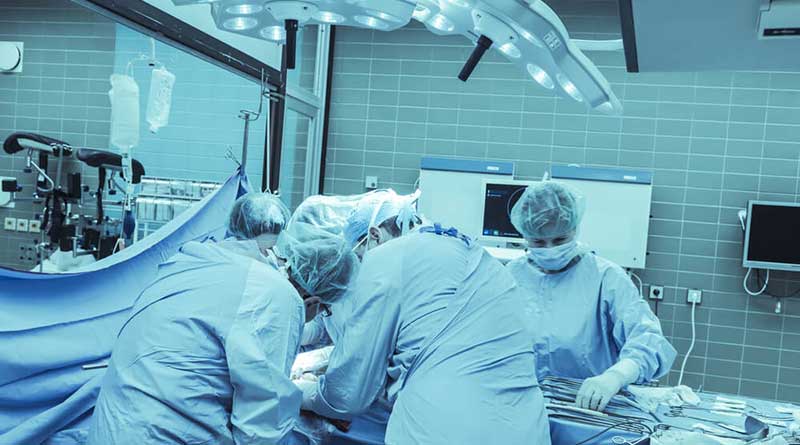
What are the indications of internal cardiac massage?
The main indication is cardiac arrest due to perforating trauma. This technique can only be performed by expert medical personnel since the risk of infection and complications is high. It is necessary to remember that it is a question of manipulating the heart with the whole thorax in the open. So it is necessary to maximize the antiseptic measures and to control the hemorrhage that is taking place.In addition, it is necessary to evaluate the massage when there is hypotension with a systolic pressure below 70 mmHg that does not respond to volume injection. This is an early sign of tamponade where the heart is failing to function properly.You always have to perform the internal cardiac massage as a last resort. That is, first we must perform less aggressive resuscitation techniques. Such as conventional cardiopulmonary resuscitation, the administration of inotropic drugs (adrenaline) to activate the sympathetic nervous system, etc.The practice of minimally invasive thoracostomy is a controversy among the medical community. Some practitioners are in favor of taking advantage of a perforating wound to access the heart. While others are more conservative and believe that internal cardiac massage should be reserved for open traumatisms that completely expose the contents of the chest cavity.In spite of everything, in this type of situation the patient is in a critical state. So survival is not ideal since it is very difficult to stabilize such complex injuries. In spite of everything, statistics show better results than a few years ago thanks to the early start of resuscitation.