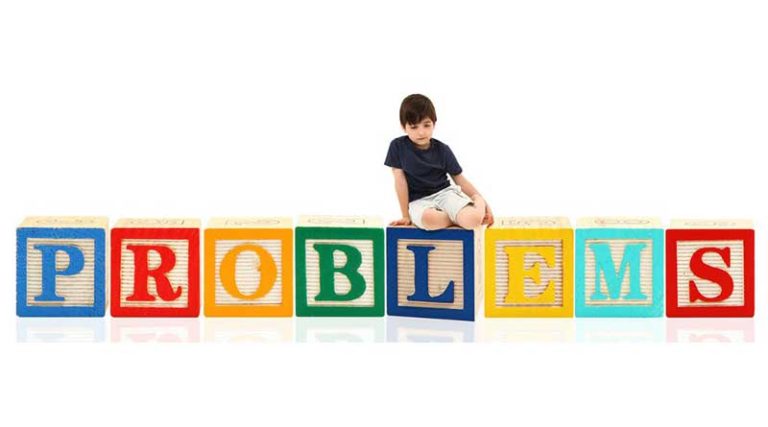
It is important that you teach your child to solve problems, since this type of circumstance can occur at any time. The ideal is to be taught to find the most appropriate solution, where the results always benefit all those involved in the conflict.
Every day, we are immersed in different conflicts. Many of them are related to other people. However, our internal problems, which are generated by the decisions we make, are not exempt.
Aspects to consider to teach your child to solve problems
It is important that children from an early age make use of reflective thinking. They must take into account the order of ideas, thinking about the facts prior to the problem and what may happen after the conflict. In this way they will be able to solve an altercation or overcome a difficulty that comes their way.
Emotional intelligence also influences the solution of problems. This specific tool strengthens our conflict resolution skills. So it is recommended to start their development in children at an early age. In this way, when they become adults they will be able to coexist without problems in society.
Recommendations to teach your child to solve problems
Here are some recommendations on how to teach your child to solve problems that may arise.
Diagnose the problem
 First of all, it is necessary for your child to learn to apply the basic points of the conflict solution. The following question must be asked: what happened? And collect all the necessary information to then form an impartial vision. Thus, you can talk about the facts from a clearer focus.
Identify the causes
After having identified the problem, it is important to know the causes. This will help solve it. To do this, you must maintain an effective communication with your child, where you can express your point of view. So he begins to develop his way of solving problems and controlling his emotions.
Teach him to be patient
Young children do not have a clear concept of time, so they get impatient easily. This action can create an internal conflict and stress them. Being calm is essential to solve problems properly. The most advisable thing is that you teach your child to be patient, so he can think before making a decision.
Motivate to share
Generally, sharing with children generates stress, which will probably give rise to a problem. It is not advisable to give things automatically to children.
They must learn that they are part of a family and a society. Where in many moments the things they have should share them well either at home or at school. It is important to be clear that they are not the only ones deserving of the benefits.
Manage empathy
As for empathy, it is important that you tell your child that you know how he feels when a problem arises, but that in many cases he should put himself in the place of the other person involved in the conflict and avoid involvement in future problems.
Focus on the positive
After talking with your child about a conflict where he has participated, you should analyze the advantages and disadvantages of each possible solution. Then he supports the positive decision he has made.
On the other hand, it is important to encourage him to comply with the solution he was willing to assume. This will allow you to learn to take responsibility for your actions and decisions made.
Exchange opinions
 Show him that exchanging opinions and discussing in groups, in a peaceful way, will allow him to recognize that he is not always right. This way you will learn that it is important to accept what someone else thinks and that is why you should not bother. On the other hand, it will help you manage and strengthen tolerance.
Positive side of conflicts
When our children begin to have experience in conflict management, they acquire very positive benefits, such as:
- Develop empathy.
- Learn to make decisions.
- Overcome difficulties.
- Solve problems with dialogue and negotiation.
- Adapt to different social media.
In conclusion, it has been identified that we all have problems throughout our lives, and children are not exempt from them. Although for adults, their problems are often not significant, for children they are of a transcendental dimension.
Therefore, you must teach your child to solve problems since childhood. This will allow you to know and make use of tools that allow you to develop strategies to avoid getting involved in conflicts or make the best decision that benefits all involved.